TL;DR: Australian partner visas are assessed across four aspects, financial, household, social, and commitment. A genuine relationship can still be refused if the documentary evidence is thin in any one of them. Evidence strategy, presentation, and timing matter as much as the relationship itself.
-
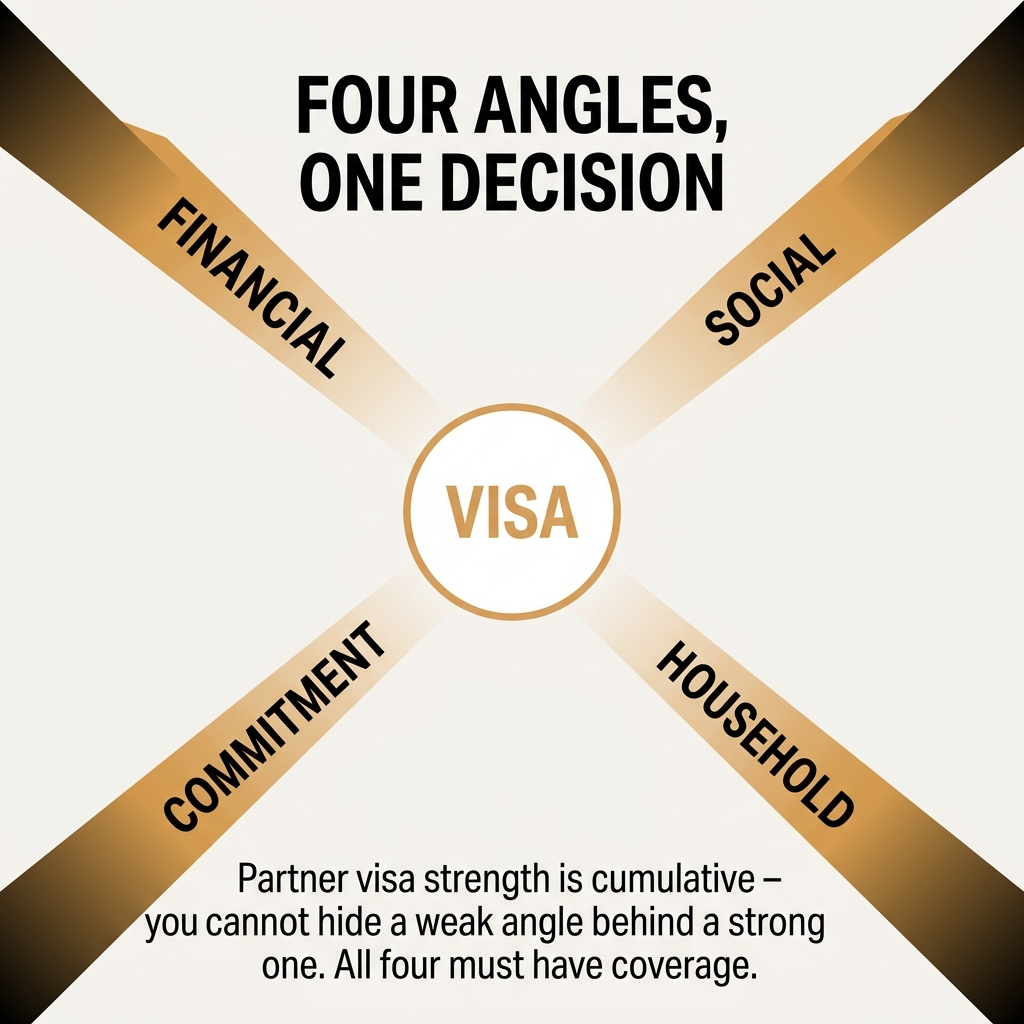
The Department of Home Affairs assesses partner visa applications across four distinct aspects: financial, household, social, and commitment.
-
Weakness in any single aspect can result in refusal, even when the relationship is entirely genuine.
-
The most common reason for refusal is insufficient evidence that the relationship is genuine and continuing.
-
Evidence must be decision-ready at lodgement, because the Department typically issues only one request for further information.
-
Starting evidence collection early matters because document dates cannot be backdated or manufactured retroactively.
Here is something that surprises capable, organised people more than almost anything else in the immigration process: a completely real relationship can be refused a partner visa. Not because the couple lied, and not because the love was thin, but because the documentary shadow their life cast happened to fall short in one narrow angle.
An assessing officer never meets your relationship. They meet the paper version of it. That single fact reshapes everything about how you should think through your evidence, because the officer is reading proxies for an intimate reality they cannot observe directly.
The Department organises those proxies into four aspects of the relationship: financial, social, the nature of your household, and the nature of your commitment. Understanding how these four aspects work together, rather than as a checklist you tick off in a hurry, is where most of the real preparation lives.
Why Does the Department Ask for So Much Evidence?
It helps to reason backwards from what the Department is actually guarding against. Partner visas carry a permanent outcome, which means the assessment exists to filter genuine relationships from arranged or convenient ones. That guarded thing, the risk of a manufactured relationship, dictates the entire evidential burden placed on you.
Once you see the assessment through that lens, the volume of documentation stops feeling arbitrary. The four aspects operate as four independent angles of light thrown onto the same shared life. Each angle catches something the others cannot, which is precisely why coverage across all four matters more than depth in any single one.
The most common reason for refusal, as practitioners across the field consistently report, is insufficient evidence that the relationship is genuine and continuing, especially where proof runs thin across one or more of the four pillars. The refusal rarely turns on character or health. It turns on documentary inadequacy.
Key Point: The four-aspect framework exists because the Department cannot observe your relationship directly. It can only read the evidence you provide, therefore, every angle must be covered.
What Are the Four Aspects of a Partner Visa Application?
The strength of your application is cumulative. You cannot compensate for a weakness in one aspect by piling extra material into another, because the Department reads all four together and a category imbalance is immediately visible to a case officer. A thin angle does not hide behind a thick one.
1. The Financial Aspect: What Evidence Do You Need?
Financial evidence tends to attract the most misunderstanding. Many couples assume they must fully merge their finances into a single joint account, and they panic when their real arrangements look nothing like that. In reality, financial arrangements vary enormously from one household to another, and many couples maintain separate banking for entirely practical reasons.
What the Department looks for is entanglement and interdependence, not a rigid account structure. Useful evidence includes:
- Shared bills and joint liabilities
- Records showing you pool resources toward common goals
- Evidence of one partner financially supporting the other
- Joint insurance, shared subscriptions, or co-signed agreements
The question is whether your money moves like the money of two people building a life together.
Key Point: Financial evidence measures interdependence, not whether you share a single bank account. Separate banking is common and acceptable, provided you can show your finances are meaningfully entangled.
2. The Nature of the Household: How Do You Prove a Shared Life?
This aspect asks how you run your shared life day to day, who does what, how you divide responsibilities, and how you present as a couple within your own home. Address evidence sits heavily here, and this is one area that has quietly modernised.
Proof of a shared address no longer depends on physical letters arriving on a doormat. Valid digital evidence includes:
- PDF lease agreements and emailed tenancy confirmations
- Online utility accounts in both names
- Digital bank statements showing the shared address
- Online government correspondence addressed to both partners
All of these count as valid household evidence when they clearly show the shared address and the relevant dates.
💡 A quiet tip: set up joint or shared digital accounts early, so the dates on your evidence stretch back naturally rather than clustering suspiciously in the weeks before you lodge.
Key Point: Household evidence has moved digital. The documents you need are likely already in your inbox, provided you started creating them early enough.
3. The Social Aspect: How Do You Prove Your Relationship Exists Publicly?
The social aspect proves that your relationship exists in the eyes of other people, not only in your own account of it. This is where statements from friends and family carry real weight, and where many applicants underplay their hand.
The Department requires a minimum of two Form 888 declarations. Submitting four to six of them, drawn from different people who genuinely know your relationship, strengthens your application considerably. Mixing family members with friends means the officer sees your relationship from several independent vantage points. Additional social evidence includes:
- Photographs together across different time periods
- Joint invitations to events
- Evidence of shared holidays and mutual friendship circles
- Social media posts or shared accounts that show the relationship publicly
Key Point: Form 888 declarations reward a thoughtful spread. Four to six statements from a genuine mix of people who know you as a couple will always outperform the bare minimum of two.
4. The Nature of Your Commitment: What Does This Aspect Actually Measure?
This aspect reaches toward the future and the depth of your bond. It is the most abstract of the four, which means it rewards specificity most of all. Evidence and content relevant here includes:
- Demonstrated knowledge of each other's background, family, and life history
- Documented future plans together (travel, property, family)
- The length and history of the relationship
- Evidence of how you support one another through difficulty
Key Point: Commitment evidence is the hardest to manufacture after the fact. Specific, detailed statements that reflect genuine mutual knowledge of each other's lives carry far more weight than general declarations of love.
Why Does Presentation Matter as Much as the Evidence Itself?
Here is a pattern that has become hard to ignore: a great many refusals stem not from a lack of a genuine relationship, but from poor presentation of a genuine one. A clear narrative supported by targeted evidence works far better than sheer volume.
Relationship quality does not guarantee approval. Evidential strategy does the heavy lifting. A tight bundle that proves the essentials across all four aspects usually reads stronger than an enormous upload that mixes your best material with your weakest, because the strong evidence gets diluted by everything crowding around it.
The task, when you frame it honestly, is making an ordinary shared life legible across four angles at once. You are proving a subjective, internal reality using external, circumstantial proof, and the officer weighs the cumulative weight of how plausibly your documents tell the story of two people sharing a life.
Key Point: A focused, well-organised evidence bundle almost always outperforms a large, unfocused one. Quality of presentation is a strategic decision, not an administrative afterthought.
Why Is Timing the Hidden Variable in Partner Visa Applications?
Timing is the piece almost nobody accounts for until it is too late. As the Department has tightened its approach, applications are now expected to be decision-ready at lodgement, with typically only one request for further information if documents are missing, and no gentle reminder if the deadline slips past you.
Processing times for the temporary stage sit somewhere around 18 to 32 months, which sounds like breathing room until you realise the evidence itself needs years of depth behind it. Reactive gathering, started after you decide to apply, already arrives late for the strongest possible result.
The care you put into presentation bends to effort. The dates on your evidence do not. You cannot retroactively create three years of shared banking or a lease from two years ago, which means the single most valuable thing you can do is begin collecting quietly today, while you live your life, rather than reconstructing it under pressure later. Trying to assemble a two-year evidence trail in a fortnight is a little like trying to map a route after you have already reached the crossroads.
Key Point: Document dates cannot be backdated. The depth your evidence needs can only be built in real time, which means early collection is one of the most valuable things you can do for your application.
Bringing the Four Aspects Together
Let me draw the threads back into one place, because the structure matters more than any single document you might chase.
-
An officer sees the paper, never the relationship, so your job is making a real shared life legible on the page.
-
The four aspects work as one portfolio, and depth in one cannot rescue a gap in another.
-
Financial evidence measures interdependence, not whether you happen to share a single account.
-
Household and social proof have gone digital, which means the evidence you need is often already sitting in your inbox.
-
Form 888 declarations reward a thoughtful spread, ideally four to six from a mix of people who know you.
Presentation and timing decide as much as substance, so a tight, decision-ready bundle built over years outperforms a rushed pile.
A partner visa is won by making a genuine, ordinary shared life visible across all four evidential aspects together, built steadily as you live it. The relationships that stumble rarely stumble on truth. They stumble on thin documentation, and that particular problem is one you can solve well in advance. Start early, cover every angle, and let the receipts your life quietly leaves behind do the work when the moment comes. It is going to take patience, but you can absolutely make it work.
Key Takeaways
-
Australian partner visa applications are assessed across four aspects: financial, household, social, and commitment. All four must be covered, depth in one cannot compensate for weakness in another.
-
The most common reason for refusal is insufficient evidence of a genuine and continuing relationship, not character or health concerns.
-
Financial evidence does not require a joint bank account. It requires proof of financial interdependence, shared bills, joint liabilities, and pooled resources.
-
Household and social evidence has moved digital. PDF leases, online utility accounts, and emailed tenancy confirmations are all valid, provided dates are clear.
-
Form 888 declarations are stronger when you submit four to six from a genuine mix of people, rather than the bare minimum of two.
-
Applications must be decision-ready at lodgement. The Department typically issues only one request for further information.
-
Evidence collection cannot be rushed retroactively. Start building your documentary record early, whilst you are living your life, not after you have decided to apply.
Frequently Asked Questions
What are the four aspects of an Australian partner visa?
The Department of Home Affairs assesses partner visa applications across four aspects: the financial aspect (shared finances and interdependence), the nature of the household (shared living arrangements and daily responsibilities), the social aspect (how the relationship is recognised by others), and the nature of the commitment (mutual knowledge, future plans, and emotional depth of the bond).
Why do genuine relationships get refused a partner visa?
Genuine relationships are refused when the documentary evidence is insufficient across one or more of the four aspects. An assessing officer cannot observe the relationship directly, they can only assess the evidence provided. Poor presentation, thin documentation in a single aspect, or a rushed evidence bundle can all result in refusal even when the relationship is entirely real.
Do you need a joint bank account to prove financial interdependence for a partner visa?
No. A joint bank account is not required. The Department looks for evidence of financial entanglement and interdependence, shared bills, joint liabilities, evidence of pooling resources, or records of one partner supporting the other. Many couples with entirely separate banking still meet this requirement.
How many Form 888 declarations should you submit?
The minimum is two, but submitting four to six declarations from a genuine mix of family members and friends strengthens your application considerably. A broader spread of independent witnesses who each know your relationship from a different angle gives a case officer far more confidence in the relationship's authenticity.
What counts as household evidence for an Australian partner visa?
Household evidence includes anything that demonstrates a shared address and shared daily life. This can include lease agreements, utility accounts, bank statements, government correspondence, and digital documents, all of which are valid provided they clearly show the shared address and relevant dates.
How early should you start collecting partner visa evidence?
As early as possible in the relationship, and certainly well before you decide to apply. Processing times for the temporary stage sit around 18 to 32 months, and the evidence itself needs years of depth to be persuasive. Document dates cannot be backdated, so reactive gathering, started only after you decide to apply, already arrives late.
What is the difference between a full lodgement service and an application review for a partner visa?
A full lodgement service covers the entire application from evidence strategy through to submission. An application review assesses evidence you have already gathered and identifies gaps before they reach a case officer. Both services are available through MigrationHotline, alongside a consultation for those at the early planning stage.
Can a previously refused partner visa application be reconsidered?
Yes, in many cases. A prior refusal does not automatically prevent a new application, though it adds complexity. The key is understanding precisely why the refusal occurred and addressing those specific gaps in the next application. Cases with prior refusals, unconventional relationship structures, or short timelines benefit significantly from specialist legal advice before re-lodgement.
Partner visa applications sit at the more demanding end of the immigration spectrum, and many of the refusals we see in our practice were entirely avoidable. The evidence was real, the relationship was genuine, and the outcome still went the wrong way because nobody had mapped the four aspects with the rigour the Department expects. At MigrationHotline, partner visas and complex cases are where we spend our professional time, which means we have seen the full range of what goes wrong and, more usefully, exactly how to prevent it.
Whether your situation is straightforward or carries complications from a previous refusal, a short timeline, or an unconventional relationship structure, I highly recommend getting proper legal eyes on it before you lodge. You can work with us on a full lodgement service, where we manage the entire application from evidence strategy through to submission, or on an application review, where we assess what you have already gathered and identify the gaps before they reach a case officer. If you are at the early stages or simply want to understand your position clearly, a consultation is the right starting point. Reach out through MigrationHotline and we can map the terrain together.