You have probably watched the migration debate play out as a single argument about size. More migrants or fewer, weighed fair concern, and it deserves attention. The trouble is that the number people fight over in headlines is rarely the number that against housing and services for people already here. It is a decides whether your project gets staffed on time.
What actually determines that outcome sits much lower down, at the level of one application moving through the system. How fast it moves. How much evidence it demands. How little it bends when your timeline slips. That is the terrain I want to walk you through, because I am starting to see the same misunderstanding cost businesses real money and real momentum.
The Demand Is Not in Question
The reliance on skilled migrant workers is well documented, particularly in mining and agriculture. Migrant workers in the minerals sector have more than doubled since 2021, and the industry still faces critical shortages. The Minerals Council estimates companies will need roughly 40,000 new migrant workers over the next three years to support current and approved projects.
Western Australia shows the pressure most clearly. Australian born workers make up only 58 per cent of the state's employed workforce, the lowest share in the country. When you read those figures together, the conclusion is hard to avoid. The workforce plan for a great deal of national economic activity assumes migration will deliver, and it assumes delivery on a schedule.
Where the Outcome Is Actually Won
Here is the part that gets lost. You can lift an annual intake target and still fail every business relying on it, because the machinery underneath decides the real result. The skilled visa system currently runs on two separate tracks, which means two very different experiences depending on which door you enter through.
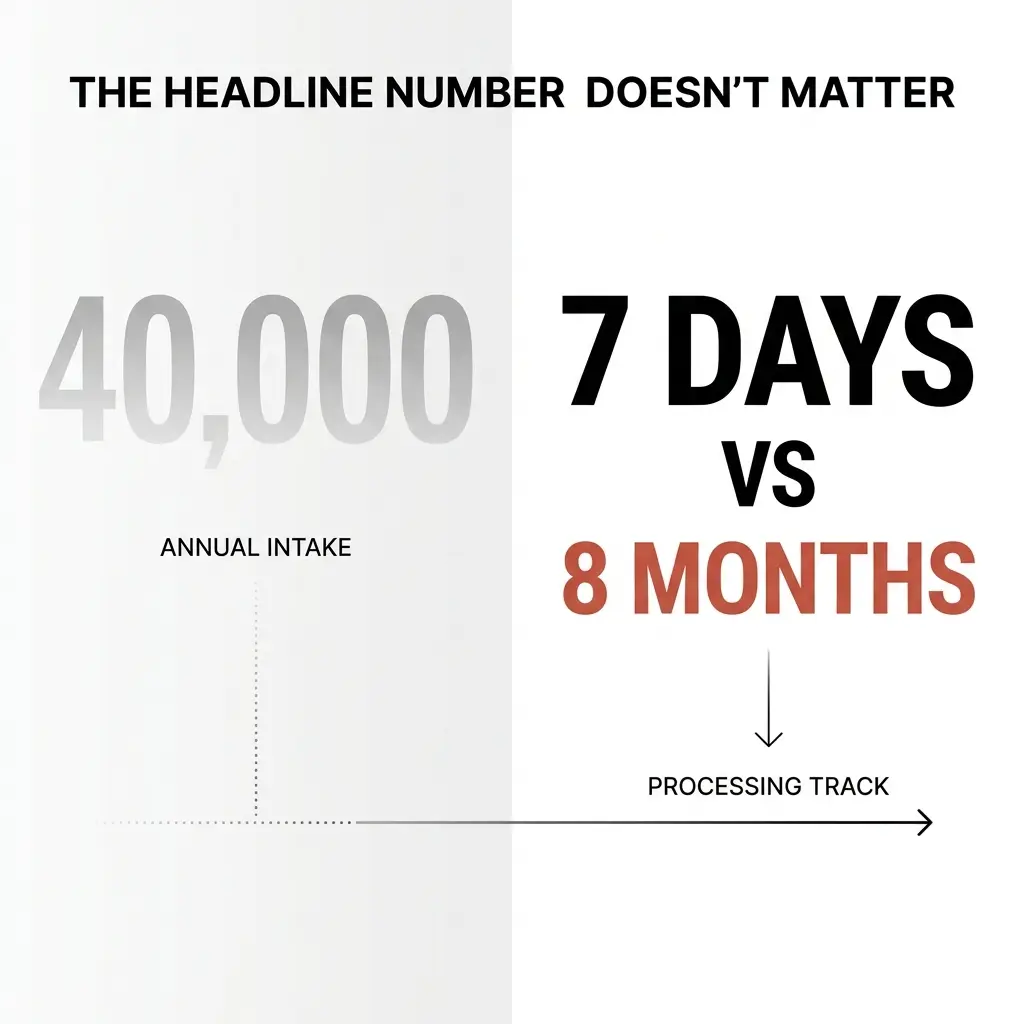
Specialist Skills candidates can be processed in around seven days, whilst Core Skills applicants wait closer to eight months. Temporary skilled visas average roughly 113 days, and incomplete applications stretch that further. If you are planning a build, a shift roster, or a seasonal harvest around those timelines, the annual figure in the news tells you almost nothing about whether your worker arrives when you need them.
This is the gap I keep watching businesses fall into. They treat the policy headline as the operative constraint, when the operative constraint is the evidence threshold and the processing behaviour attached to their specific pathway. That is where the outcome is genuinely determined.
The Risk That Quietly Changes Hands
There is a second layer here, and it matters for how you think about worker protection as much as delivery. When a party can lower a standard to cut cost or reduce friction, someone downstream absorbs the risk that gets shed. You see this when operators move away from structured schemes toward more flexible temporary channels to avoid higher obligations.
Temporary workers, including those on working holiday visas, fill genuine gaps in regional communities and agriculture. That flexibility is valuable and often essential. The concern surfaces when the switch to a cheaper channel comes with weaker protections, because the person carrying the new risk is usually the one with the least power to refuse it. Having navigated an opaque system myself, with no support and no map, I understand how quickly a newcomer becomes an easy target for anyone willing to take advantage.
So the operational detail is not only where economic delivery is decided. It is also where protection either holds or fails. Both outcomes are settled in the same place, and it is not the annual number.
How to Think About the Cost Differently
Getting this wrong is expensive in ways that do not show up until later. It can cost up to A$20,000 per candidate once you account for training, licensing, equipment and sponsorship, and higher salary thresholds and fees arrived on 1 July 2026. I would encourage you to read that figure as an investment in a future outcome rather than a charge you pay today, because the decision you make about the pathway shapes whether that spend delivers or evaporates.
The practical move is to plan against the machinery, not the headline. Map your roles to the correct visa track before you commit to a start date. Assess where your case is objectively strong and where it depends on evidence you still need to assemble. Build your timeline around realistic processing behaviour rather than the number quoted in the news. It is going to be demanding work, and with the right sequencing you can make it work.
What to Carry Away
Australia's economic reliance on migrant workers is real, and the industries voicing concern are not exaggerating their exposure. The point I want to leave with you is where the decision actually lives. Not in the size of the intake, but in how the visa system performs at the level of your individual application, where delivery and worker protection are settled together.
If you take one thing from this, let it be a shift in attention. Watch the processing tracks, the evidence thresholds, and the channel you choose for each role, because that operational detail is the lever you can genuinely move. The headline number will keep changing, and the machinery underneath is what determines whether your plan holds.