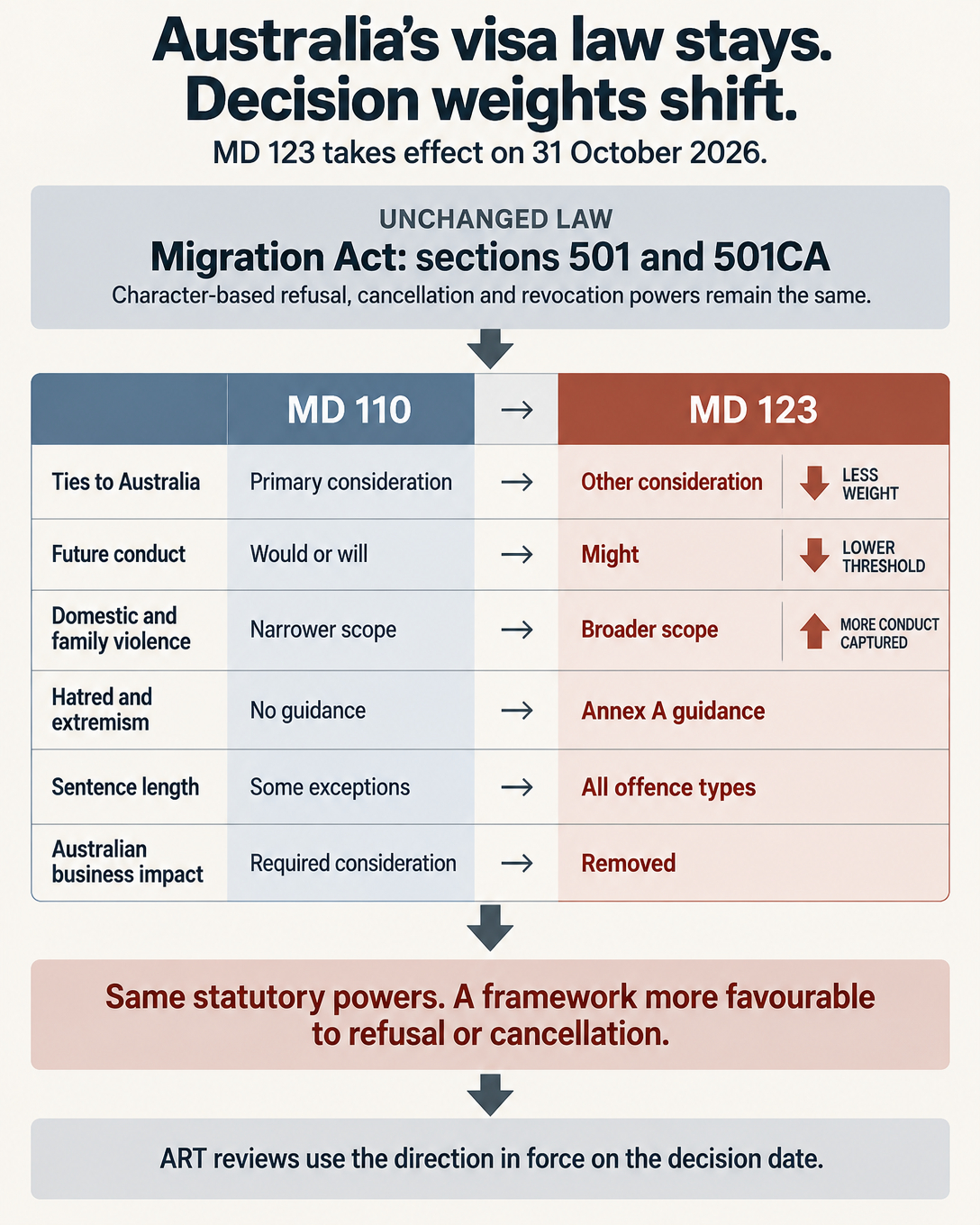
TL;DR From 31 October 2026, Ministerial Direction 123 (MD 123) replaces Ministerial Direction 110 (MD 110) for character-based visa refusals, cancellations and revocations under sections 501 and 501CA. The Migration Act itself has not changed, but the weighting has, and because nearly every shift favours refusal or cancellation, your evidence now has to work harder than before.
- Ties to Australia drop from a primary consideration to an “other consideration”, so they carry less weight.
- The future risk test falls from whether you “would” reoffend to whether you “might”, which makes rehabilitation evidence critical.
- Domestic and family violence is defined more broadly, and the hatred and extremism ground now has detailed guidance.
- Sentence length counts for every offence type, and the impact on Australian business interests is no longer considered.
- The ART applies MD 123 to any review decided on or after 31 October 2026, even if the delegate used MD 110.
One small word could decide whether you keep your visa. Under the new direction, a decision-maker no longer has to find that you would reoffend, only that you might, and that shift starts landing on real people from 31 October 2026. On 18 September 2026, Minister Tony Burke signed Ministerial Direction 123, which replaces Ministerial Direction 110 (signed by Minister Andrew Giles on 7 June 2024 as the successor to Direction 99).
If you hold an Australian visa and your history could attract character scrutiny, this document now shapes your future. I want to walk you through what changed, why it matters and what I recommend you do next, in plain English and without the jargon that so often sits between people and their own cases. Many people in this position are quietly worried and unsure who to ask (which is completely understandable), so let us work through it together.
What Is MD 123, and Does It Change the Law?
One point first, because it trips up a lot of people. MD 123 does not change the Migration Act 1958. Section 501 (refusal or cancellation on character grounds) and section 501CA (revocation of mandatory cancellations) remain exactly as they were.
What has changed is the instruction manual telling decision-makers how to weigh your circumstances under those sections. In my experience, the weighting is where cases are actually won and lost, therefore a new direction can move outcomes a lot even though the statute has not moved at all.
Key point: MD 123 leaves the Migration Act untouched and changes only how decision-makers weigh your circumstances, which is where character cases are usually decided.
Which Decisions Does MD 123 Apply To?
MD 123 guides every decision-maker using discretion under section 501 to refuse or cancel a visa, and every section 501CA decision about whether to revoke a mandatory cancellation. It also binds the Administrative Review Tribunal (the ART), which has replaced the AAT in the direction's language.
Which direction applies to your case?
The transitional rules deserve your close attention, because they catch people out. Departmental delegates deciding a case before 31 October 2026 apply MD 110. The ART, in contrast, applies whichever direction is in force on the day it decides. Therefore, if a delegate refused you under MD 110 and your review is decided on or after 31 October 2026, the ART will assess you under MD 123, using rules that did not exist when your case was first argued.
I highly recommend you confirm which framework will actually govern your matter, and prepare your evidence for that one rather than the one you started under.
Key point: Delegates use MD 110 until 31 October 2026, but the ART uses whatever direction is in force on its decision day, so reviews already underway can switch to MD 123 partway through.
What Are the Six Biggest Changes in MD 123?
1. Primary considerations drop from five to four (and ties to Australia lose their place)
MD 110 listed five primary considerations. MD 123 lists four, and the one that disappeared is your ties to Australia. The strength, nature and duration of your connection to this country now sit among the “other considerations”, which carry less weight in the balancing exercise.
The four primary considerations that remain are:
- protection of the Australian community from criminal or other serious conduct
- domestic or family violence
- the expectations of the Australian community
- the best interests of minor children in Australia
For long-term residents, this one stings. If you have lived here for twenty years, raised a family here and know no other home, those facts still count, but they count less than they did under MD 110. Because of that, your evidence needs to lean harder on the four considerations that remain primary.
2. The risk threshold drops from “would” to “might”
Under MD 110, decision-makers asked whether you would or will engage in further conduct. Under MD 123, they ask whether you might. Honestly, that one word does a massive amount of work, because almost anyone with a history of offending “might” reoffend in some abstract sense, so the bar drops considerably.
This means your evidence of rehabilitation becomes even more critical than it already was. The materials that can persuade a decision-maker that even the lower “might” threshold tips in your favour include:
- treatment records
- psychological reports
- demonstrated insight into your offending
- stable employment
- completed programmes
Without that evidence, an application in this space cannot succeed. I say that as someone who has had to deliver that news to people who were hoping for a softer answer, and it never really gets easier.
3. Domestic and family violence is defined far more broadly
MD 123 expressly extends the definition of domestic and family violence to include image-based abuse, stalking, breaching court orders, and violence within caregiving relationships and cultural family groups. Decision-makers must now also consider the effect of the conduct on victims and witnesses, with particular attention to minor children who were exposed to it.
If your history includes anything within that wider definition (even conduct that never led to a conviction), you should expect it to feature prominently in your assessment. A frank, evidence-based response prepared early will serve you far better than hoping it slips through unnoticed.
4. New guidance on the hatred and extremism character ground
In January 2026, the Combatting Antisemitism, Hate and Extremism Act 2026 inserted section 501(6)(baa) into the Act, a new character ground covering hatred and extremism. MD 110 had no guidance on it. MD 123 now does, through Annex A, which covers:
- membership of or association with terrorist organisations
- connections to a state sponsor of terrorism
- involvement with a prohibited hate group
- hate crime conduct
- hateful public statements
This is uncharted territory for decision-makers, and the early cases decided under this guidance will shape how broadly it gets read. If anything in your history could conceivably fall within these categories, public statements included, I highly recommend you seek advice before the Department raises it with you.
5. Sentence length now counts for every offence type
MD 110 carved certain offence categories out of its sentence-weighting framework. MD 123 removes that carve-out entirely, so the length of any sentence you received now feeds into the seriousness assessment, whatever the offence type. MD 123 also expands “very serious conduct” to include hate crime conduct and drug or property offences attracting sentences of five years or more.
6. Impact on Australian business interests is gone
MD 110 required decision-makers to weigh the impact of their decision on Australian business interests. That gave sponsored workers and business owners a real argument about what their removal would mean for employers and enterprises. MD 123 removes this consideration entirely. Therefore, if you hold an employer-sponsored visa and face character issues, an argument that used to carry weight has simply gone.
Key point: Taken together, these six changes tilt the balance toward refusal or cancellation, so the evidence you submit now has to carry more of the load than it did under MD 110.
How Does MD 123 Compare With MD 110?
- Primary considerations: MD 110 had five, including ties to Australia. MD 123 has four, with ties to Australia demoted to an “other consideration”.
- Future risk threshold: MD 110 asked whether you “would” or “will” engage in conduct. MD 123 asks whether you “might”. Domestic and family violence: MD 110 used a narrower definition. MD 123 expressly includes image-based abuse, stalking, breaches of court orders, caregiving relationships and cultural family groups, plus the effect on victims, witnesses and children.
- Hatred and extremism ground, s501(6)(baa): MD 110 had no guidance. MD 123 adds Annex A guidance on terrorist associations, state sponsors of terrorism, hate groups, hate crimes and hateful public statements.
- Sentence length weighting: MD 110 excluded certain offence categories. MD 123 applies it to all offence types, adding hate crimes and 5+ year drug or property sentences to “very serious conduct”.
- Australian business impact: a required consideration under MD 110, removed entirely under MD 123.
- Review body: AAT under MD 110, ART under MD 123.
Key point: Nearly every substantive change in this comparison moves the balance toward refusal or cancellation, which is why preparing under the old assumptions is so risky.
What Smaller Changes Could Still Affect Your Case?
Several smaller amendments will matter in individual cases, and they are easy to miss:
- **Community expectations now expressly include complying with migration laws **and leaving Australia when your permission to stay ends, which gives past visa non-compliance new relevance.
- The best interests of minor children now split into four sub-factors: current and future risk of abuse, neglect, exposure to domestic and family violence, and psychological or economic abuse. Your evidence about children therefore needs to be more structured and specific than before.
- The risk assessment for temporary visa holders has changed, and decision-makers must now consider the difficulties a person would face in third countries. This can help people who cannot safely or practically return to their country of citizenship.
Each of these shifts looks small on paper, and any one of them can decide a case in practice.
Key point: Small amendments around migration compliance, children's interests and third-country hardship can each tip an individual case, in either direction.
What Should You Do Now If You Have a Character Matter?
I think it helps to treat this as a short checklist rather than one big, scary job. Here is what I recommend, in order:
- Confirm whether your decision will land before or after 31 October 2026, because that determines which direction governs your case (and at the ART it will be MD 123, whatever the delegate applied).
- Have your evidence reviewed against the new framework now, so you are not discovering the mismatch at the hearing.
- If your case leans heavily on your ties to Australia, build supplementary evidence aimed at the four remaining primary considerations, particularly rehabilitation material that answers the lower “might” threshold.
- If your history touches domestic and family violence in any form, or anything that could engage the new hatred and extremism ground, get advice before you respond to the Department.
Getting the strategy right early is far easier than trying to repair it once the Department has set the timeline for you. It will take some work, but with the right evidence in place, a well-prepared case under MD 123 is still very much winnable.
Key point: The strongest position under MD 123 comes from knowing which direction governs your case and building your evidence for that framework early.
Frequently Asked Questions About MD 123
When does MD 123 start?
MD 123 commences on 31 October 2026. Minister Tony Burke signed it on 18 September 2026, and it replaces MD 110.
Does MD 123 change the Migration Act 1958?
The Act stays the same, and sections 501 and 501CA remain exactly as they were. MD 123 changes how decision-makers weigh your circumstances when they apply those sections.
My delegate decision was made under MD 110. Which direction will the ART use?
The ART applies whichever direction is in force on the day it decides. If your review is decided on or after 31 October 2026, the ART will assess you under MD 123.
Do my ties to Australia still count?
They still count, but they count less. They now sit among the “other considerations” rather than the primary considerations, so your evidence should also target the four remaining primary considerations.
What does the “might” threshold mean for me?
Decision-makers now ask whether you might engage in further conduct, rather than whether you would or will. Because that bar is lower, rehabilitation evidence such as treatment records, psychological reports and stable employment matters more than ever.
Can domestic violence conduct count against me without a conviction?
Under MD 123's broader definition, you should expect conduct within it to feature prominently in your assessment, even if it never resulted in a conviction.
Can my value to my employer still help my case?
The business impact consideration has gone. MD 123 removes the impact on Australian business interests entirely, so that argument no longer carries weight in the framework.
Is the hatred and extremism ground new?
Section 501(6)(baa) was inserted in January 2026 by the Combatting Antisemitism, Hate and Extremism Act 2026. MD 110 had no guidance on it, and MD 123 now provides guidance through Annex A.
Key Takeaways
- MD 123 replaces MD 110 from 31 October 2026, and the Migration Act itself is unchanged.
- Ties to Australia are now an “other consideration”, so long-term residence carries less weight.
- The risk test has dropped from “would” to “might”, which makes strong rehabilitation evidence essential.
- Domestic and family violence is defined more broadly, and the hatred and extremism ground now has detailed guidance in Annex A.
- Sentence length counts for every offence type, and Australian business impact is no longer considered.
- The ART applies MD 123 to reviews decided on or after 31 October 2026, so cases already in the system are affected too.
How MigrationHotline Can Help With Your MD 123 Case
From 31 October 2026, a decision-maker reading your file will ask whether you might reoffend, and the only answer they will weigh is the evidence in front of them. That evidence is the one part of your case you still control, and under MD 123 it carries more weight than ever. We built MigrationHotline for people in exactly this position.
When you work with MigrationHotline, you work with our principal directly, from the first assessment through to your ART hearing, with no hand-off to a junior associate learning on your time and money. We handle section 501 refusals and cancellations and section 501CA revocation requests, and we actively take on the complex cases that other advisers have written off as too hard.
We will tell you honestly where you stand. If we take your case on, you will know the costs and the realistic outcomes upfront, explained in plain English.
The MD 123 changes make preparation harder, but a well-built case is still very much winnable, and an early start gives us more room to gather the rehabilitation evidence the new “might” threshold demands. I highly recommend you book a confidential case assessment with MigrationHotline before 31 October 2026, or as soon as you receive any notice from the Department, so we can map out your strategy together.