Finding an Australian visa sponsor comes down to one discipline: aiming at the right employers with the right evidence. The strategies below are ordered to help you do exactly that, moving from research and eligibility through to application, interviews, and follow-up.
Read the Demand Signal Before You Move
Employer-sponsored places in the 2026 to 2027 Permanent Migration Programme rose from 44,000 to over 58,000 in a single year, according to this sponsorship analysis. According to Jobs and Skills Australia, 29percent of assessed occupations sit in national shortage, with trades and healthcare roles, registered nurses, general practitioners, and allied health professionals, carrying the heaviest and most persistent gaps. Confirm whether your occupation sits inside that shortage terrain before you plan anything else, because that single fact determines how much friction you will face at every stage that follows.
Qualify Yourself Against the Rules
From 1 July 2026, the Core Skills Income Threshold sits at $79,423 and the Specialist Skills Income Threshold at $146,576, as detailed in this threshold breakdown. In some instances you also need a completed skills assessment and qualifications that match an eligible skilled occupation. The strongest position is when your occupation appears on both the Occupation Shortage List and an eligible skilled occupation list simultaneously, that combination tends to produce faster processing and more nomination opportunities.
💡 Tip: Gather your skills assessment, qualification documents, and salary evidence before you approach any employer. An employer cannot begin the sponsorship process without that proof, and arriving without it stalls conversations that would otherwise move quickly.
Run a Reverse Search, Not a Broadcast
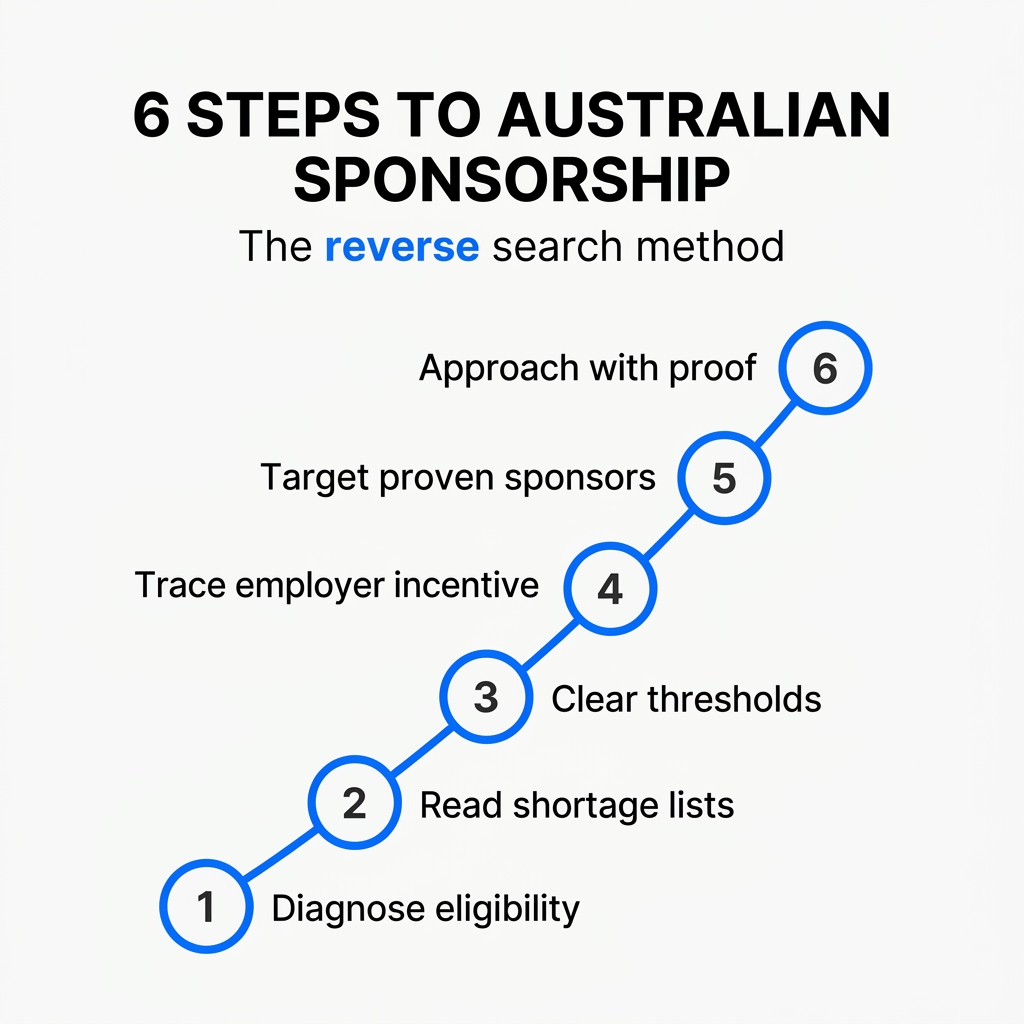
Target employers with a proven sponsorship history rather than applying broadly. Filter that list by your occupation and shortage category, confirm the role matches an eligible occupation, and approach with evidence that you clear the income threshold.
Use Specialist Recruitment Agencies as a Bridge
Search for agencies that explicitly list visa candidates or immigration placement in their service offering, a generalist recruiter will frequently screen you out the moment sponsorship is mentioned. When you make contact, provide your occupation, skills assessment status, visa subclass, and the salary threshold your role clears. That precision signals that you understand the process, which changes the quality of the conversation considerably and increases the likelihood that the agency will actively present your candidacy to employers already considering sponsorship.
Approach Regional Employers Directly
Regional businesses across New South Wales, Queensland, South Australia, and Western Australia are carrying some of the sharpest vacancy gaps in trades, healthcare, and agriculture-adjacent technical roles, and many have never sponsored before simply because they did not know where to begin. Research regional councils, hospital networks, and local business directories to build a target list. A direct, professional approach to a regional employer, one that names their specific shortage and explains how you address it, surfaces opportunities that no job board will ever list.
Utilise Job Portals Strategically
On general platforms such as Seek, Indeed, and LinkedIn Jobs, filter by the salary bands that clear the income threshold and by the regions where shortages are most acute. Sponsorship-specific portals, Visa Jobs Australia and WorkVisa.com.au, are structured around eligible roles and remove significant noise from the search. The Australian Government's JobSearch platform also surfaces roles where employers have indicated openness to visa candidates, particularly in regional areas. Before applying to any role, confirm the company appears on a known sponsorship history list and that the salary offered genuinely clears the current threshold.
Build Professional Visibility Before You Apply
Engage with the content and discussions of your target companies on LinkedIn before making a formal approach, comments on industry posts, contributions to relevant groups, and a profile that speaks clearly to the shortage you solve all build recognition that makes your eventual approach warmer. When contacting hiring managers directly, keep messages brief, specific, and evidence-led: name the gap you address, reference your qualification and visa eligibility plainly, and focus on opening a conversation rather than closing an outcome.
Tailor Your Resume and Cover Letter to the Sponsorship Context
Your resume needs to surface your skills assessment status, occupation code, and target salary in the opening summary, not buried in a footnote. Your cover letter should acknowledge the sponsorship requirement briefly and directly, then focus its remaining space on demonstrating the specific value you bring to the employer's documented shortage. Each application should reference the company's known shortage and industry sector specifically, because a tailored approach signals the level of research that persuades an employer to take on a process they would not undertake for a generic candidate.
Prepare for Interviews as a Sponsorship Candidate
Be ready to speak clearly about your visa situation: the subclass you are targeting, your skills assessment status, your intended timeline, and the costs and obligations the employer will carry. Employers unfamiliar with the sponsorship process will raise concerns, your ability to address those calmly and accurately often determines whether a promising conversation becomes an offer. Prepare specific examples of the value you have delivered in equivalent roles, and arrive with questions that demonstrate genuine interest in the business, because employers sponsoring for the first time are particularly sensitive to candidates who treat the visa as the objective rather than the role.
Follow Up and Stay Persistent
Send a brief, professional follow-up seven to ten days after any application or initial approach, referencing the specific role and adding one concrete point you wanted to reinforce. Sponsorship conversations frequently convert months after the initial contact, when a vacancy shifts, a preferred candidate withdraws, or a business finally decides to pursue the process it had been weighing. Staying connected through LinkedIn, industry events, and periodic non-pressured check-ins keeps you visible across that longer arc without requiring a new application each time.
The Path in Summary
Read the demand signal. Confirm your occupation sits in a documented shortage before planning your search.
Qualify yourself first. Clear the income thresholds, complete your skills assessment, and gather your evidence.
Run a reverse search. Start from companies with a sponsorship history, then aim with proof.
Use specialist recruiters. Approach agencies that place visa candidates with precise eligibility information.
Approach regional employers directly. The sharpest shortages sit outside the capital cities, and a direct approach surfaces opportunities no job board lists.
Use job portals strategically. Filter by salary, region, and shortage occupation, and verify sponsorship history before applying.
Build professional visibility. Engage with target companies before you apply so that your formal approach lands warmly.
Tailor every application. Surface your eligibility clearly and address the employer's specific shortage directly.
Prepare for the sponsorship layer of interviews. Know your visa situation in detail and reduce the employer's uncertainty about the process.
Follow up and stay persistent. Sponsorship conversations that do not convert immediately often convert months later.
I highly recommend beginning with the eligibility check this week. Everything else moves considerably faster once you know precisely where you stand.
Have You Found a Potential Employer Or Are You an Employer Looking to Sponsor Overseas Workers?
If you are a business considering sponsoring a skilled overseas worker, whether you are starting the process for the first time or looking to transfer the nomination of an existing 482 visa holder, MigrationHotline offers a free initial consultation to help you understand exactly what is involved, what it will cost, and whether your business is well-positioned to proceed.
Sponsorship is manageable when you have the right guidance from the beginning. The consultation is an opportunity to ask the questions that matter for your specific situation, without commitment and without obligation. To book your free consultation, get in touch with Anna directly through MigrationHotline`s booking page.