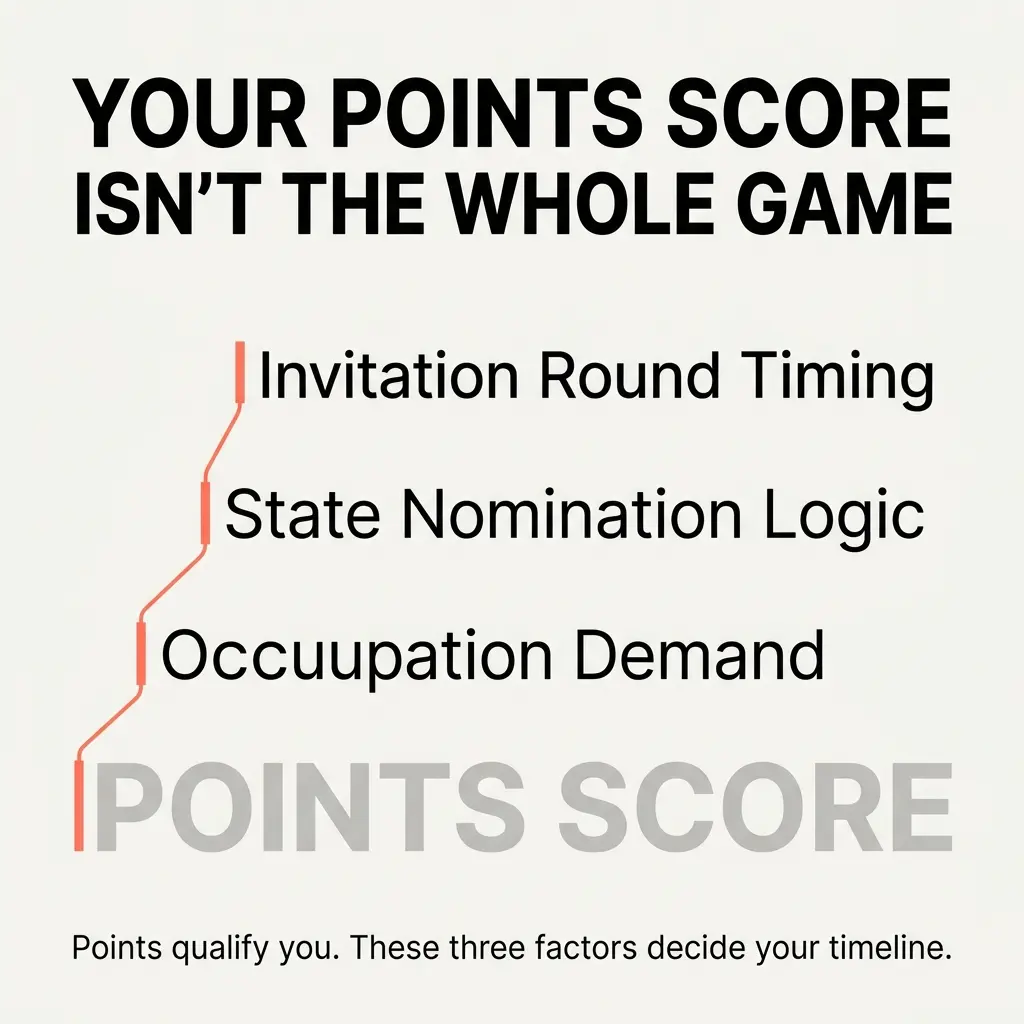
TL;DR: A high points score qualifies you to be considered for an Australian skilled migration invitation. It does not guarantee one. Occupation demand, state nomination logic, and the current behaviour of invitation rounds carry far more weight than your total alone.
-
Points are a threshold condition, not a selection guarantee.
-
Your occupation's demand ceiling shapes your wait more than your score does.
-
Each state runs its nomination programme around its own economic priorities.
-
Invitation rounds have become significantly less predictable in recent years.
A fuller strategy analyses occupation, state pathway, and timing together.
The Gap Between the Score and the Outcome
I find myself saying this to consultation clients most weeks, and it still catches many of them off guard. A high points score feels like the whole game. You run the calculator, you reach a number you are proud of, and you assume the invitation will follow. Then it does not arrive on the timeline you pictured, and the plan you built starts to feel uncertain.
I want to widen the lens here, because the number was never the whole picture. Points qualify you to be considered. What happens after that depends on factors you have to research rather than calculate.
Someone arrives with 85 points, certain that the total alone carries them across the line. Then they watch a person on 70 receive an invitation first. The disappointment is real, and it is worth sitting with, because it points to something useful. The system is not broken in these moments. The expectation was built on one visible metric, whilst the actual decision rests on a wider set of moving parts.
The score opens a door. It does not walk you through it.
I have come to see that much of the friction in skilled migration traces back to this gap between what someone expects and how the process genuinely operates. Once you treat the score as your place in the queue rather than the finish line, the real work becomes visible.
Key Point: Your points score determines eligibility, not priority. The selection outcome depends on factors that sit well beyond the calculator.
The Three Factors That Sit Above the Score
I am starting to see these three factors decide outcomes far more often than the points total does. They are not hidden, but they require the kind of patient, specific research that a points calculator does not prompt you to do.
1. Your Occupation Shapes Your Timeline
Two people with identical points totals can wait very different lengths of time depending on what they do for work. The occupational ceiling on your particular pathway sets how many invitations that field receives in a given round, which means demand for your occupation shapes your wait far more than any calculator reveals. This is the part applicants most often assume is simple. It turns out to be the part that quietly decides the result.
Key Point: Occupation demand is the single most underestimated variable in skilled migration planning.
2. State Nomination Runs on Its Own Logic
Each Australian state runs its nomination programme around its own economic priorities, which means your points total becomes one line in a much longer assessment. The state that suits your occupation best is not always the one that comes to mind first. Reading state priorities takes proper research, and the most suitable pathway is often the one you would only find by digging for it.
Key Point: State nomination is not a uniform process. Each state's priorities shift independently, and your best pathway requires specific, current research.
3. Invitation Rounds Have Become Less Predictable
A score that generated an invitation within weeks two years ago can now sit in the queue for months. This is a signal, not a fault. It reflects how demand in certain occupation groups has shifted over time, and planning as though the queue will behave the way it once did is where I see the most friction in practice.
Key Point: Round unpredictability is a feature of a responsive system, not a flaw. Your planning needs to account for it rather than work around it.
What a Fuller Strategy Actually Looks Like
When I first had to work out an unfamiliar migration path, I had no one to guide me. I learned that the parts of the process you assume are straightforward are usually the parts that quietly decide everything. That experience shaped how I approach every case now.
A realistic strategy asks what your outcome truly depends on, and separates the parts you control from the parts you do not. You control the quality of your research and the pathways you choose to pursue. You do not control the rhythm of invitation rounds, so you plan around it instead of hoping it behaves the way it did before.
The applicants who plan around this fuller picture hold the genuine advantage. They are not relying on a single number. They are reading occupation demand, state pathway options, and a timeline grounded in how rounds behave right now, which means their planning holds up under pressure in a way that a points-only approach simply does not.
Key Point: The genuine strategic advantage belongs to applicants who analyse the full selection picture rather than optimise for a single metric.
A Practical Way Forward
If you are banking your future on one number, I highly recommend you step back and analyse the full selection picture instead. That means looking at your occupation demand, your available state pathway options, and a realistic timeline that accounts for current round behaviour.
This work is more complex than a points calculator suggests. That complexity is precisely where the real strategy lives. It is going to take more effort, and it will reward you for it.
Frequently Asked Questions
Does a higher points score guarantee an invitation?
No. A higher points score improves your eligibility threshold, but it does not guarantee an invitation. The selection outcome also depends on occupation demand, state nomination priorities, and the current behaviour of invitation rounds.
Why did someone with fewer points receive an invitation before me?
Because points are not the only selection criterion. Occupation demand, the specific pathway being used, and state nomination priorities all influence who receives an invitation and when. A lower-scoring applicant in a high-demand occupation can receive an invitation ahead of a higher-scoring applicant in a saturated field.
How do I know which Australian state is the best fit for my occupation?
Each state publishes its own nomination priorities, and those priorities shift regularly based on economic conditions. The most suitable state for your occupation requires specific, current research rather than a general assumption about which state is most accessible.
How often do invitation rounds run?
Invitation rounds operate on a schedule that varies by visa subclass. The number of invitations issued in each round, and the minimum points score required, shift depending on demand within specific occupation groups at the time of the round.
What does occupation demand mean in practice?
Each occupation on the skilled occupation list has a ceiling on how many invitations it can generate within a given pathway. When demand for a particular occupation is high relative to that ceiling, waiting times extend, regardless of where your points total sits.
Can I improve my chances without increasing my points score?
Yes. Choosing a less saturated occupational category, identifying a state nomination pathway that prioritises your occupation, and timing your application around current round behaviour can all improve your chances without changing your points total.
Is the invitation round system broken?
No. The variability in round outcomes reflects a system that responds to shifting labour market demand. The challenge is not the system itself, it is the expectation that the system will behave the way it did at a different point in time.
How far in advance should I be planning my skilled migration strategy?
The fuller your picture of occupation demand, state pathway options, and round behaviour, the earlier you want to be working on it. Many applicants underestimate how much lead time a well-researched strategy requires, and the cost of that underestimation tends to show up at exactly the wrong moment.
To Recap
Your points score is the entry condition, not the assurance of an invitation. Three factors sit above it: the demand attached to your occupation, the specific logic of each state nomination programme, and the current, less predictable behaviour of invitation rounds.
Qualifying on points earns you a place in the assessment. The genuine advantage belongs to the applicants who research the occupation, state, and timing factors that actually decide the invitation. Plan around the whole picture, and you give yourself a far steadier footing on the way through.
Key Takeaways
Your points score qualifies you to be considered. It does not determine whether you receive an invitation.
Occupation demand is the most underestimated variable in the selection process, and it shapes your timeline more than your score does.
Each Australian state runs its nomination programme around distinct economic priorities, which means the best pathway for your occupation requires specific research.
-
Invitation rounds have become less predictable. Planning as though they will behave as they once did is a somewhat suboptimal approach.
-
The applicants who hold the genuine advantage are those who analyse occupation demand, state pathway options, and round timing together, rather than relying on a single metric.
-
The complexity of the full selection picture is not a barrier. It is precisely where the real strategic opportunity lives.