Most employers who receive a nomination refusal never saw it coming, because the problem was sitting in a document they considered entirely routine.
A business finds the right worker. The role is permanent. Everyone in the room understands that. The employment contract goes out with a standard probation period, the sort of clause that appears in almost every offer letter across the country, and then the subclass 186 Employer Nomination Scheme nomination is lodged. A case officer reads that clause, and the interpretation they form from it is the one that matters, regardless of what the employer intended when they drafted it.
Early in my career, I assumed that genuine intention would carry significant weight in these assessments. After working through enough employer-sponsored matters, I came to understand that the assessment stage operates on evidence, and the contract is the primary piece of evidence on the table. The case officer reads the arrangement as it is written, and the relationship in the room does not travel with the document.
What the ENS Nomination Actually Requires
The foundation of a subclass 186 nomination is deceptively straightforward on its face. The employer must demonstrate a genuine need for the worker in a full-time, ongoing position, and that position must remain available for at least two years following the visa grant. This is a mandatory threshold, not a guideline, and case officers scrutinise it actively. The position must be genuine and ongoing from the date of grant, with the employer holding the operational and financial capacity to sustain the role for the full period.
Case officers interpret the word ongoing to mean permanent. That single interpretive standard is where an ordinary probation clause begins to create a serious problem.
Why a Probation Clause Works Against the Nomination
A probation clause gives an employer the right to end an employee's contract during an early period without the standard notice requirements. Its function is to allow the employer to assess suitability before confirming permanent employment, which means, by definition, it describes employment that remains conditional until the probation period concludes.
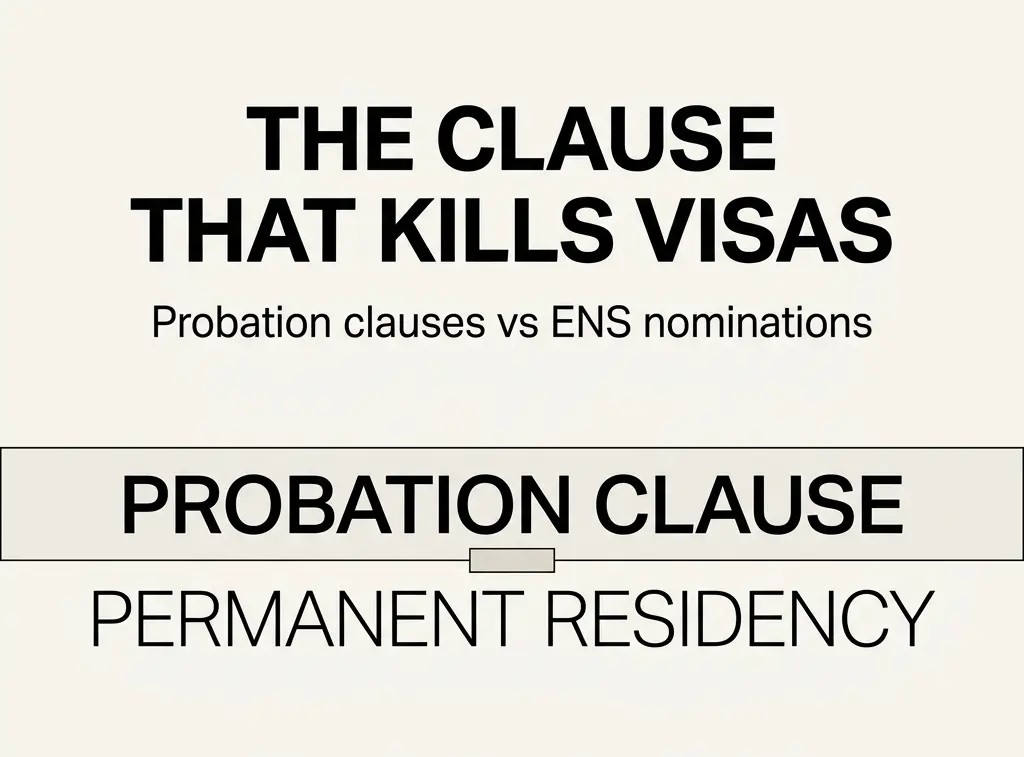
The visa requirement asks for employment that is permanent and ongoing at the moment of lodgement. When a case officer encounters a probation clause, the document is telling them the position could still end, and that reading sits in direct conflict with the permanency the law requires. The contract has already made the argument before anyone has had the opportunity to explain what was meant by it.
Good faith does not survive the assessment stage. The wording in the contract does, and it speaks on behalf of the employer whether or not it reflects their actual intention.
The Gap Between Intention and Evidence
This is the part I find myself explaining most often, because it is the part that surprises employers the most. An employer can hold a completely genuine intention to retain someone for years, and the employment contract can quietly undermine that intention through a clause no one stopped to examine.
The employment contract serves one primary function in a nomination: it demonstrates to the Department of Home Affairs that the employer intends to offer the employment for the required period. Where the wording includes termination rights during probation, the evidence works against the stated position, and the case officer has no obligation to look past what the document says. Across the matters that reach my desk, refusals in this area rarely originate from weak roles or uncommitted employers. They come from routine documentation that nobody thought to question before lodgement.
Still Within Probation Versus Already Past It
There is a distinction worth understanding carefully here, because it determines what the fix looks like.
Where the worker is still within their probation period at the time of lodgement, the employment is conditional in the most direct sense, the contract says the position could end, and the assessment reflects that. Where the worker has already completed probation, many employers assume the problem has resolved itself. It has not resolved entirely. A contract that still carries the probation wording continues to describe a conditional arrangement to a reader who was not present for the successful completion of that period. The clause keeps speaking even after its practical purpose has passed, which means the wording requires attention regardless of where the worker sits in their employment timeline.
What a Refusal Actually Costs
I ask employers to weigh these two numbers honestly before they lodge.
A nomination refusal does not simply delay the process. When the nomination fails, the visa application fails alongside it, and both outcomes may require separate appeals to the Administrative Appeals Tribunal, meaning the appeal fee is paid twice. For the business, a refusal disrupts workforce planning, affects retention, and introduces uncertainty into future sponsorship arrangements. For the worker, it can close off a permanent residency pathway they have spent years building toward, with consequences that extend well beyond the immediate application.
Set that against the cost of a contract review before lodgement. The difference is not a close comparison. The prevention is modest in cost, and the failure it prevents is the kind that alters the trajectory of someone's life in Australia.
How to Protect the Nomination Before Lodgement
The fix belongs at the drafting stage, well before any visa is considered. There is meaningful room to address this properly when it is identified early, and the steps are straightforward once the risk is understood.
-
Review the contract through the case officer's lens. Read the employment agreement looking specifically for wording that describes the role as conditional rather than permanent, probation clauses, performance review termination rights, and fixed-term language all warrant scrutiny.
-
Remove or restructure the probation clause before lodgement. Where the position is genuinely permanent, the conditional language should come out of the contract before the nomination is filed, or be restructured so the document reflects the ongoing nature of the role.
-
Provide formal evidence of probation completion. Where the worker has already passed their probation period, a formal letter from the employer confirming successful completion gives the case officer the clarity the contract wording alone does not provide.
-
Build the permanency argument into the supporting documentation. A well-drafted employer support letter, paired with a clean contract, gives the case officer an affirmative case for permanency rather than a gap they need to resolve through further enquiry.
A single oversight in the contract wording is sufficient to generate a request for further information or an outright refusal. A pre-lodgement review is risk management at its most practical, and it costs a fraction of what remediation requires once a refusal is on the record.
The Principle Behind the Problem
What makes this particular issue somewhat insidious is that it originates in good practice. Probation clauses exist for sound HR reasons, and the employers who include them are generally the ones who take employment arrangements seriously. The difficulty is that immigration law and employment law operate according to different standards, and a clause that is entirely appropriate in one context can create a significant liability in the other.
I would rather walk you through that distinction now, at the point where it can be addressed cleanly, than explain it after a refusal has already been recorded. The contract review happens before lodgement, the nomination is protected, and the worker's pathway to permanent residence stays on track. It takes a little care at the right moment, and that is precisely where the difference is made.