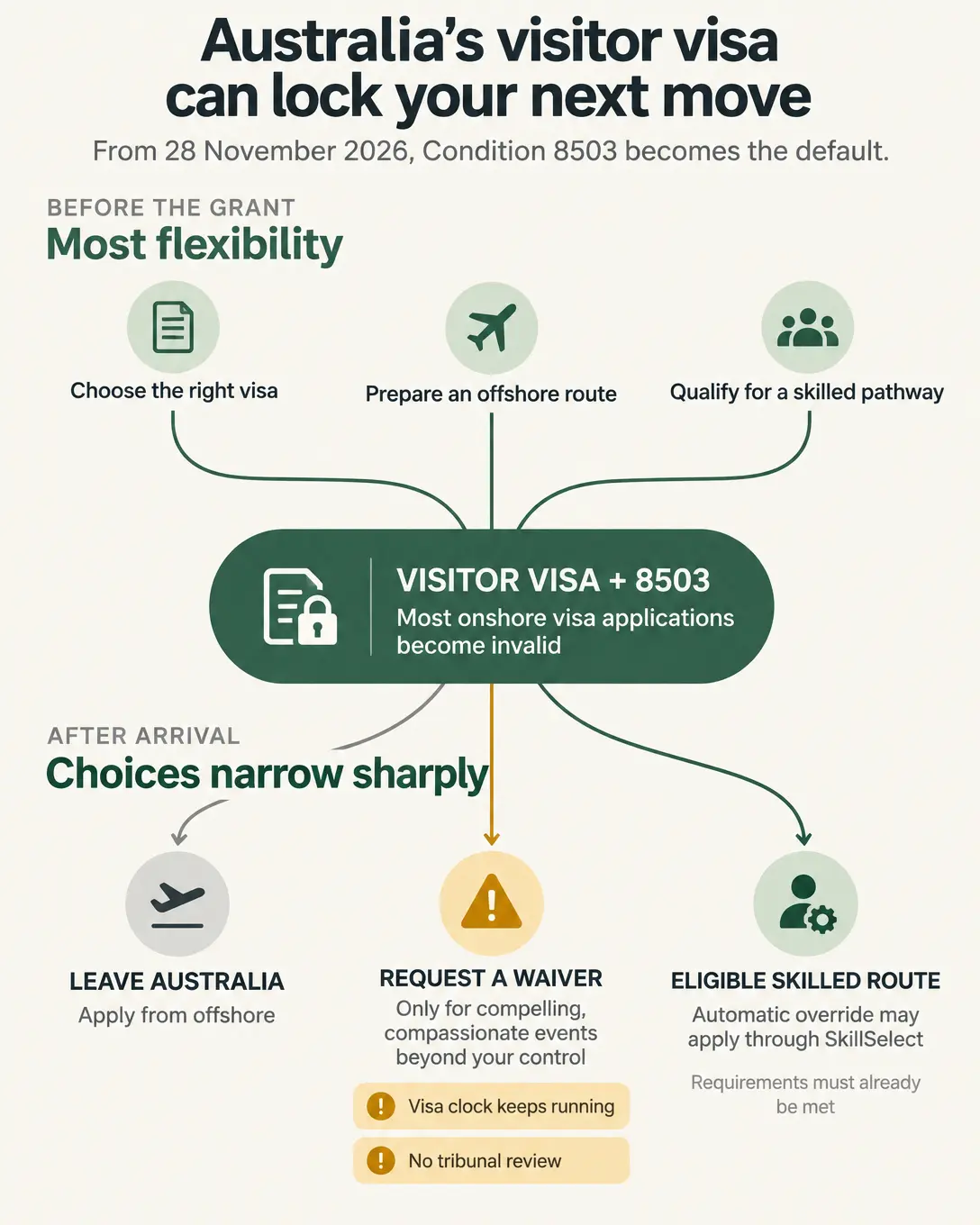
In short: From 28 November 2026, condition 8503 (the No Further Stay condition) becomes mandatory on new applications for the main Australian visitor visas, which means many visitors who later want a partner, work or skilled visa will need to leave Australia and apply from outside, unless a waiver applies.
-
The change comes from the Migration Amendment (Preventing Further Stay for Visitor Visas) Regulations 2026 (F2026L01503), which amend the Migration Regulations 1994.
-
The date you lodge your application decides whether 8503 attaches, so an application made before 28 November 2026 falls outside the new rule, whenever you travel.
-
The general waiver under regulation 2.05(4) needs compelling and compassionate circumstances that arose after the grant, and the Administrative Review Tribunal cannot review a refusal.
-
A separate skilled waiver under regulation 2.05(4AA) covers GSM and listed employer-sponsored visas, and departmental policy currently treats it as automatic on lodgement.
If you have ever thought you could fly in on a visitor visa, look around, and sort out the longer-term visa once you arrive, that plan now has a closing date. Condition 8503, the No Further Stay condition, is a decision about your future choices that the government writes down before you land, and it is about to sit on the main Australian visitor visas by default.
From 28 November 2026, the condition attaches as a matter of course to new applications for the subclass 600, the eVisitor (651) and the Electronic Travel Authority (601). The legal source is the Migration Amendment (Preventing Further Stay for Visitor Visas) Regulations 2026 (F2026L01503), which were signed on 12 November and registered the following day, amending the Migration Regulations 1994.
I work with these conditions every day, and I want to walk you through what this shift means in practice, because the detail carries far more weight than the headline (the detail is where your options either survive or quietly disappear).
What does condition 8503 actually do?
When condition 8503 sits on your visa, you cannot lodge a valid application for most other substantive visas whilst you remain in Australia. The condition is set out in Schedule 8 to the Migration Regulations 1994, and it draws its authority from section 41(2)(a) of the Migration Act 1958, which allows a visa to carry a condition that its holder will not be granted a substantive visa, other than a protection visa, whilst in Australia. Because the restriction is written into the grant itself, there is no officer to reason with at the airport and no caseworker to persuade later.
In practice, this leaves you two routes: you depart before your visa expires, or you request a formal waiver of the condition. The power to waive sits in section 41(2A) of the Migration Act 1958, and the general test appears in regulation 2.05(4) of the Migration Regulations 1994. That test requires compelling and compassionate circumstances that were beyond your control, that developed after your visa was granted, and that caused a major change to your situation.
Two details in that test deserve your full attention, because they catch out a surprising number of capable, well-organised applicants.
First, a pending waiver request does nothing to extend your visa, so the clock keeps running whilst you wait (and the Department works to its own timetable, which rarely matches yours). Second, the Department states plainly that the Administrative Review Tribunal cannot review a waiver refusal, which means a refused waiver is, in most situations, the end of that road.
The compelling and compassionate circumstances giving rise to your waiver request must be beyond your control and need to have developed since the visa was granted.
The Department has set that threshold deliberately high. The system resists improvisation, so your planning has to happen before the grant, whilst you still hold every option.
Where this leaves you: Condition 8503 closes most onshore visa applications, and the general waiver under regulation 2.05(4) is narrow and unreviewable, so the safest time to plan is before you apply.
Why is Australia making this change now?
This change belongs to a wider tightening of temporary migration, and once you understand the direction of travel, you can plan with far more confidence.
The onshore route from visitor visa to student visa closed on 1 July 2024. That closure operates through subitem 1222(4) of Schedule 1 to the Migration Regulations 1994 and the Migration (Specification of Categories of Visas that Preclude a Person from Lodging a Student Visa Application in Australia) Amendment Instrument (LIN 24/051) 2024, which amended IMMI 16/016 to specify the subclass 600 visa in its entirety. Because it is a legislated block, it applies whether or not 8503 appears on your grant. The scale explains the response: more than 36,000 applications moved from visitor to student status between July 2023 and May 2024.
Minister Burke has stated that the main purpose of placing No Further Stay conditions on visitor visas is to stop non-citizens lodging Partner visas inside Australia. The impact reaches well beyond that single category, however, because 8503 blocks most onshore applications, whatever their type.
The government estimates these reforms will reduce temporary visa numbers by around 85,000 within twelve months, and up to 180,000 temporary visa holders may need to leave Australia by July 2026 if they cannot secure a valid pathway. Figures of that size point to structural policy that the government intends to hold for years.
The bigger picture: The 8503 change follows the 2024 closure of the visitor-to-student route, and the government's own estimates suggest these restrictions are here to stay.
How does the skilled visa waiver work?
This is the detail that many applicants overlook, and for ambitious professionals it changes the whole calculation.
Under regulation 2.05(4AA) of the Migration Regulations 1994, the Minister may waive condition 8503 where you genuinely intend to apply for a General Skilled Migration visa or a subclass 186, 187, 188, 191, 482 (Skills in Demand) or 494 visa. The 187 and 188 are still named in the regulation, although both are now closed to new applicants. Once a waiver is granted on this ground, regulation 2.07AG limits your valid onshore applications to the visa categories it specifies, so the waiver opens one defined route and leaves the others closed.
Departmental policy treats this ground as operating automatically. The Department of Home Affairs takes the position that, by operation of regulation 2.05(4AA), a skilled applicant does not need to lodge a separate waiver request, because applying for a listed skilled visa is treated as sufficient. That automatic effect comes from policy, since the regulation itself says the Minister may waive, so it can change without any legislative amendment. The ground is also available only whilst you still hold the visa carrying the condition, which means an expired visitor visa closes this route entirely.
I highly recommend you build this waiver into your plan from day one, well before you are onshore and short on time. It works for applicants who already hold a competitive occupation, a credible points position and documents ready to go. If you arrive hoping to assemble those pieces onshore under time pressure, the process will feel like pushing against a wall that gives nothing back.
The opening worth knowing: Regulation 2.05(4AA) gives skilled and employer-sponsored applicants a real way through 8503, although it depends on departmental policy, the limits in regulation 2.07AG and a visa that is still current.
What should you do before you travel?
If you already hold a visitor visa, this change leaves your current grant untouched. Under the transitional provision in the amending regulations, the mandatory condition applies to visa applications made on or after 28 November 2026, so your lodgement date decides whether 8503 attaches, regardless of when you travel. Recently granted subclass 600 visas already carry 8503 with increasing frequency, however, including visas granted to parents of permanent residents, so your existing grant deserves a careful read too.
This is the sequence I recommend to every client in this position:
-
Read your grant notice on the day it arrives. The condition code appears on the document itself. Checking it takes two minutes and protects months of planning.
-
Decide your real intention before you apply. If a partner visa, a skilled application or a business pathway sits anywhere in your plans, build the strategy around an offshore or pre-structured lodgement, because waiting for onshore circumstances to cooperate is a somewhat optimistic plan under 8503.
-
Map every branch to its end. For each possible outcome (grant with 8503, grant without it, refusal), play the pathway through before you commit money to flights, housing or employment conversations.
-
Treat the general waiver as a last resort. The compelling and compassionate test is strict, the clock does not pause, and a refusal carries no tribunal review.
It is going to be harder to change course onshore than it was two years ago, and I will not soften that. We can still make it work, because the system rewards people who read the detail early and commit to a mapped route before they board the plane.
Your next move: The applicants who come through this well are the ones who check their lodgement date, read the grant notice for 8503 and settle their longer-term plans before they apply.
What does this shift tell you about Australian migration?
I used to view conditions like 8503 as administrative housekeeping, a single line of code on a grant letter. After years of working on cases where that one line decided everything, I read it differently now: the condition is the government stating, in advance, how much flexibility it will give you, and the honest answer today is very little.
I am starting to see authorities put predictable visitor flows ahead of individual convenience, and the burden of proof has moved firmly onto you, the applicant, before arrival. For professionals between 27 and 39 weighing a move to Australia, this is a signal worth reading early, and it is far from a reason to give up. The system still holds genuine pathways, including the skilled waiver under regulation 2.05(4AA) that departmental policy currently treats as automatic, and those pathways reward the people who prepare.
The direction of travel: Flexibility after arrival is shrinking, so the decisions that shape your outcome now happen before you lodge, at a pace you can still control.
Frequently asked questions
What is condition 8503?
Condition 8503 is the No Further Stay condition, set out in Schedule 8 to the Migration Regulations 1994 under section 41(2)(a) of the Migration Act 1958. It stops you being granted most substantive visas, other than a protection visa, whilst you remain in Australia.
Which visas will carry condition 8503 from 28 November 2026?
Under the Migration Amendment (Preventing Further Stay for Visitor Visas) Regulations 2026 (F2026L01503), the condition becomes mandatory on new applications for the main visitor visa categories, including the subclass 600, the eVisitor (651) and the Electronic Travel Authority (601).
Does the change affect a visitor visa I already hold?
The new rule applies to applications made on or after 28 November 2026, so it leaves your existing grant untouched. Many recent subclass 600 grants already carry 8503, however, so your current grant notice deserves a careful check.
Can condition 8503 be waived?
The power to waive sits in section 41(2A) of the Migration Act 1958. Regulation 2.05(4) allows a waiver for compelling and compassionate circumstances that arose after the grant, and regulation 2.05(4AA) allows a waiver where you genuinely intend to apply for a listed skilled or employer-sponsored visa.
Does a pending waiver request extend my visa?
A pending waiver request does nothing to extend your visa, so your visa can expire whilst the Department considers the request.
Can I challenge a refused waiver?
The Department states that the Administrative Review Tribunal cannot review a waiver refusal, which is why a well-prepared first request matters so much.
Is the skilled visa waiver automatic?
Departmental policy treats the regulation 2.05(4AA) ground as automatic when you lodge a listed skilled visa, although the regulation itself says the Minister may waive. Regulation 2.07AG then limits which onshore applications are valid, and the ground applies only whilst you still hold the visa carrying the condition.
Can I move from a visitor visa to a student visa onshore?
That route closed on 1 July 2024 through subitem 1222(4) of Schedule 1 to the Migration Regulations 1994 and LIN 24/051, and it stays closed whether or not 8503 appears on your grant.
Key takeaways: what matters most
To recap the essentials from everything above:
-
From 28 November 2026, condition 8503 attaches to the main Australian visitor visa categories by default, moving from discretionary to mandatory.
-
The waiver test in regulation 2.05(4) demands compelling and compassionate circumstances beyond your control, a pending request does not extend your stay, and a refusal carries no tribunal review.
-
A skilled visa waiver under regulation 2.05(4AA) covers GSM and employer-sponsored subclasses, departmental policy currently treats it as automatic on lodgement, and it rewards applicants who prepared before arrival.
-
Existing visa holders are unaffected by the new rule, though many recent subclass 600 grants already carry the condition, so your grant notice deserves a careful read.
-
Your lodgement date, rather than your travel date, decides whether the mandatory condition applies to you.
The decisive work in migration now happens before the grant, in the fine print and in the route-planning. If your plans involve anything more than a holiday, I highly recommend you settle the strategy before you book the flight, and we will make the rest of the journey work from there.