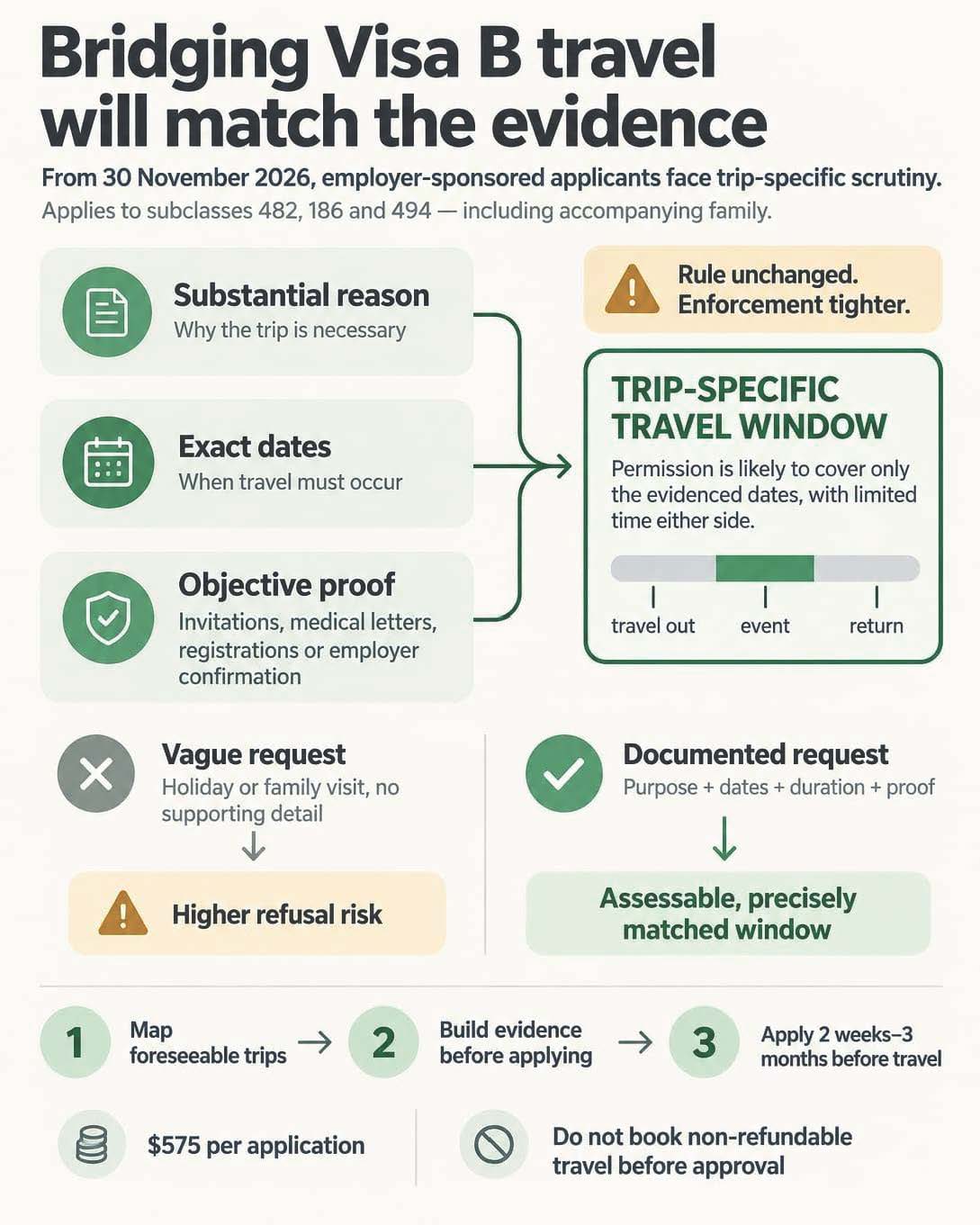
In short: From 30 November 2026, the Department of Home Affairs will apply the existing “substantial reasons for travel” rule to Bridging Visa B (BVB) requests far more strictly. For employer-sponsored applicants, this means travel windows sized to one specific trip, so the evidence you prepare in advance will decide whether you travel and for how long.
-
The law itself has not changed, because Migration Regulation 020.212(2)(d) has always required substantial reasons for travel. The Department is simply applying it more strictly.
-
Your travel window will match the trip you describe, often with only one or two extra days on either side.
-
Applicants for Subclass 482, 186 and 494 visas (and their accompanying family members) are affected.
-
A general “I want a holiday” statement may not be enough on its own, so you will need a detailed explanation backed by evidence.
-
Applications lodged before 30 November 2026 keep the current approach, although undecided ones may still feel the change.
If you are waiting on an employer-sponsored visa in Australia and you have a trip in mind, your Bridging Visa B is about to become a lot less forgiving. From 30 November 2026, the Department of Home Affairs will assess travel requests with far more rigour than applicants are used to. Therefore, the applicants who plan early will travel, whilst the ones who book flights first may find themselves at home holding a refusal. We want to walk you through what is changing, why it is happening, and what you can do about it well before the deadline arrives.
The part that surprises many of our clients is this: the legislation has not changed at all. The requirement for substantial reasons for travel has been sitting in the regulations the entire time, and what changes on 30 November 2026 is how strictly the Department applies it.
That one detail shapes everything we recommend below (and, honestly, it is good news, because a stricter reading of an old rule is something you can prepare for).
What is changing with the Bridging Visa B on 30 November 2026?
For years, the Department granted Bridging Visa B travel windows generously. If you held a pending employer-sponsored application, you could ask to travel and receive a lengthy window almost as a matter of course, even when you only had a single trip in mind. The update aligns decision-making with Migration Regulation 020.212(2)(d), which has always required substantial reasons for travel.
From 30 November 2026, that generous approach ends. The Department will look at your stated purpose, your proposed dates and your expected duration, and then grant a travel window that reflects exactly that trip.
To put it in real terms, if you are attending a business conference, your travel window will likely cover the conference dates plus one or two additional days on either side. That is it.
💡 Tip: each Bridging Visa B application costs $575. Because each window now covers one trip, several planned trips can mean several separate applications, so loose planning becomes expensive rather quickly.
Where this lands: The Department is applying an existing rule more strictly, which means your travel window will now be sized to one specific trip.
Who is affected by the Bridging Visa B changes?
These changes fall on employer-sponsored applicants and their accompanying family members. The affected visas are:
- Skills in Demand visa (Subclass 482)
- Employer Nomination Scheme (Subclass 186)
- Skilled Employer Sponsored Regional visa (Subclass 494)
In practice, this covers a large share of the skilled professionals, managers and tradespeople currently waiting onshore for a decision. If you are in that group, we highly recommend you read the rest of this piece carefully, because the approach that worked last year could lead to a refusal next year.
Quick check: If you have a pending 482, 186 or 494 application (or you are a family member on one), the new approach applies to your travel requests.
Why will “I want a holiday” no longer be enough?
Under the new approach, a general statement that you want a holiday or want to visit family may not, by itself, show substantial reasons for travel. The Department now expects a detailed explanation backed by evidence. If your trip involves a seriously ill family member, for example, documents about those circumstances will help the delegate assess your request properly.
This adds a paperwork load that many applicants will not see coming, which is why we are writing about it now. The applicants who tend to struggle when rules tighten are the ones who treated the request as a formality, booked flights first, and pulled their evidence together afterwards (an approach we would describe, kindly, as somewhat optimistic).
We used to think of the travel request as the main event, but in our own practice we have come to see it differently. Under this new regime, the strength of your request is mostly decided before you lodge it, by how complete your evidence is. Once you understand that the decision rests on objective criteria and the proof on file, the tightening becomes a step you can plan for well in advance.
The real shift: Your evidence now carries the request, so a detailed, documented reason for travel matters far more than a general one.
Why is the Department making this change?
Understanding the reasoning helps, because it tells you where the system is heading. The Department has said this adjustment will let it redirect processing effort toward substantive visa and nomination decisions, which supports better processing times overall.
Bridging Visa B applications had become a heavy administrative load. Because shorter, trip-specific windows take less time to assess than open-ended requests, delegates can spend more of their time on the decisions that actually shape your future in Australia.
For you, there is a genuine upside here, since your substantive application may move faster. The trade-off is less travel flexibility whilst you wait, and that is something you can plan around if you start early.
The silver lining: You give up some travel freedom, and in return the Department aims to process your main application faster.
What happens if you apply before 30 November 2026? Applications lodged before 30 November 2026 will continue to be assessed under the current, more generous approach. Therefore, if you know you will need to travel soon, lodging your Bridging Visa B application before that date is the most practical step you can take right now.
We do need to add a note of caution, because honesty matters more to us than tidy advice. Applications lodged before the deadline but still undecided after it may still be affected. Lodging early is a strong advantage and well worth pursuing, but it is not an absolute guarantee.
⚠️ Warning: avoid paying for non-refundable flights or accommodation before your Bridging Visa B is approved. The Department itself recommends this, and under the new regime the risk of your bookings not matching your granted travel window rises considerably.
Timing matters: Lodging before 30 November 2026 gives you the best chance at the current approach, so it makes sense to act now and hold off on bookings.
How should you prepare for the Bridging Visa B changes? Five steps
Based on everything above, this is the sequence we highly recommend.
-
Map your travel needs for the next twelve months now. Identify every trip you can reasonably foresee, including family obligations, business travel, and conferences, so that nothing arrives as a surprise.
-
Lodge before 30 November 2026 where possible. Any travel you can anticipate before the deadline should be covered by an application lodged under the current approach.
-
Apply within the recommended window. The Department advises lodging between two weeks and three months before planned travel. Last-minute applications under the new regime risk refusal or a travel window too short to be useful.
-
Build your evidence file before you apply. Gather invitations, medical letters, conference registrations, employer confirmations, and anything else that substantiates your stated purpose. The delegate decides on what is in front of them.
-
Match your request precisely to your trip. State your purpose, dates, and duration accurately, because the granted window will mirror them.
If you feel stuck on any of these steps, it may be worth asking whether your situation is complex enough to need professional advice. Pending applications with unusual circumstances, prior refusals, or family members on linked applications benefit a great deal from a properly structured approach.
The route in five steps: Plan your year of travel, lodge early, apply inside the recommended window, build your evidence first, and match your request exactly to your trip.
Where does this leave you?
We realise news like this lands heavily when your life is already on hold waiting for a decision. Having moved countries ourselves and built a life from scratch in a new one, we understand the particular stress of putting your plans at the mercy of an uncertain process. It is going to take more effort than before, and we are confident you can make it work with early, thorough preparation.
To recap: from 30 November 2026, the Department will assess Bridging Visa B travel requests strictly against the substantial reasons requirement that has always been in the regulations. Travel windows will match specific trips, general holiday statements will carry little weight on their own, and each application costs $575. Applications lodged before the deadline keep the current approach, though undecided ones may still feel the change.
The way through: Lodge early, document thoroughly, apply two weeks to three months before travel and wait for your grant before booking anything non-refundable. Because your evidence will have done the heavy lifting long before a delegate opens your file, this tightening becomes a step you can take with confidence.
Frequently asked questions
Has the Bridging Visa B law changed?
No. Migration Regulation 020.212(2)(d) has always required substantial reasons for travel. From 30 November 2026, the Department will simply apply that requirement more strictly.
Which visa applicants are affected?
Applicants for the Skills in Demand visa (Subclass 482), the Employer Nomination Scheme (Subclass 186) and the Skilled Employer Sponsored Regional visa (Subclass 494), along with their accompanying family members.
How long will my travel window be?
Your window will be tailored to the trip you describe. For a business conference, for example, it will likely cover the conference dates plus one or two days on either side.
Is wanting a holiday or a family visit enough of a reason?
A general statement may not be enough on its own. The Department now expects a detailed explanation backed by evidence, such as documents about a seriously ill family member.
How much does a Bridging Visa B application cost?
Each application costs $575. Because each window now covers one trip, several trips can mean several applications.
When should I apply before travelling?
The Department advises lodging between two weeks and three months before your planned travel. Last-minute applications risk refusal or a travel window too short to use.
Will applying before 30 November 2026 protect me?
Applications lodged before the deadline are assessed under the current approach. However, applications still undecided after 30 November 2026 may still be affected, so lodging early is a strong advantage rather than a guarantee.
Should I book flights before my Bridging Visa B is approved?
The Department recommends avoiding non-refundable flights or accommodation until your Bridging Visa B is approved, because your granted window may not match your bookings.
The most important takeaways
-
The substantial reasons rule has been in the regulations all along, and from 30 November 2026 the Department will apply it strictly.
-
Travel windows will match one specific trip, often with just one or two extra days.
-
Subclass 482, 186 and 494 applicants and their family members are affected.
-
A detailed, evidence-backed reason for travel now matters far more than a general one.
-
Lodging before 30 November 2026 is a strong advantage, though not a guarantee if your application is still undecided after that date.
-
Apply two weeks to three months before travel, and hold off on non-refundable bookings until your grant arrives.
Need help with your Bridging Visa B application?
If you are planning to travel, a senior immigration lawyer at MigrationHotline can check your reasons and evidence before you lodge, so that you do not spend $575 on an application that is unlikely to succeed. We highly recommend you get in touch before 30 November 2026, whilst the current approach still applies.